Bengaluru: Two years ago, the govt announced state dementia action plan to address dementia as a public health priority and to reduce the stigma associated with the disease apart from conducting screenings and establishing a registry. Cut to present: Not much progress has been made despite studies showing that the dementia rate in Karnataka is higher than the national average.
Experts from Nimhans said an international study from 2024 showed the rate of dementia among people above the age of 60 in Karnataka stood at 7.6%, while the national average was 7.4%. Nimhans and Dementia Alliance of India (DIA), along with the health department, submitted a draft action plan to the govt over a year ago. The govt constituted an interdepartmental task force for the implementation of the draft, which has only convened one meeting so far.
"A clearly costed, time-bound implementation plan with dedicated budget lines and a district-wise roll-out schedule is yet to be finalised. While there is visible commitment, full operationalisation across districts is still pending. At present, activities are concentrated in select regions and need to be scaled statewide. Establishing a statewide dementia registry (with protocols for data flows, privacy safeguards, and routine reporting from primary care) remains to be completed," said Radha S Murthy, president of DIA.
Officials of the health department and health minister Dinesh Gundu Rao did not respond to queries, regarding the delay in implementation, or future plans of the action plan.
Need for awareness
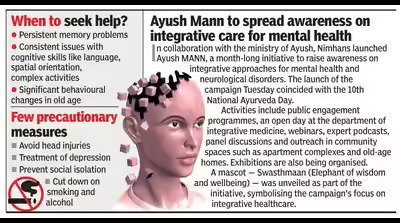
Clinicians pointed out while there is some awareness about dementia in urban areas, the rural population remains largely uninformed, highlighting the need for more awareness campaigns. "Not even 10 per cent of people with dementia are walking in healthcare centres. Most people think dementia is just a normal part of ageing, especially in rural settings," said Dr Sivakumar P Thangaraju, professor and head, geriatric psychiatry unit, Nimhans.
He also flagged although rare, early onset dementia is being seen in people as young as 35-40 years, especially if there is a family history. "If there are reversible factors like vitamin deficiency, depression, a small stroke or infection, then it is better if it is treated earlier. In most cases, people seek help only when dementia has progressed to moderate or advanced levels," Dr Sivakumar added.
Nimhans is currently running clinical trials to study the role of integrative medicine, including yoga in dementia treatment. Doctors are also training caregivers to provide electric stimulation to the brain in necessary cases under tele-supervision.
"Children of parents with dementia/Alzheimer's can sign up for research we are doing to study genetic effects. We also encourage brain donation after death of those with dementia for research as more studies need to be done with better outcomes," he said.